 Skip to content


How to Calculate Your Social Media Advertising Budget for Influencer Campaigns
Setting an advertising budget for an influencer campaign should not feel like a guess. One of the most common questions we get is “how much should I spend on social advertising to amplify the content created by influencers for this campaign?” The answer is almost always: it depends on what you want to achieve, and on which platform you want to run.
This blog walks you through:
- The four main campaign objectives on social media advertising
- Why your channel choice and objective both affect your CPM and CTR
- A practical formula to calculate your budget by working backwards from your goal
- Two worked examples for Instagram and TikTok
A note on scope: this blog focuses on amplification through TikTok Spark Ads and Instagram Branded Content Ads, since these are by far the most commonly used amplification formats for influencer marketing campaigns. The same logic applies to other platforms, but the benchmarks and calculation inputs will differ.
The four main campaign objectives on social media
Before you can calculate a budget, you need to know what you are optimising for. Both Meta Ads and TikTok Ads offer a similar set of campaign objectives, each with its own logic and its own typical cost profile.
| Objective | Funnel stage | What the algorithm optimises for | Key metrics |
|---|---|---|---|
| Reach and impressions | Awareness | Showing your ad to as many people as possible within your target audience | CPM, reach, frequency |
| Video views and watchtime | Awareness | Users who actually watch your content for a certain duration (3-second views on Instagram or 6-second views on TikTok are the most commonly used) | View rate, average watchtime, CPV |
| Clicks and traffic | Consideration | Users likely to click through to your website or landing page | CTR, CPC |
| Conversions and sales | Conversion | Users likely to complete a specific action on your site (purchase, signup, download) | CPA, ROAS, conversion rate |
Conversion campaigns require a tracking pixel installed on your site to feed the algorithm the data it needs. Without a pixel, the algorithm cannot learn which users to target for the desired action.
Why channel choice and objective both affect your costs
Here is something that catches many brands off guard: your CPM and CTR vary significantly depending on which platform you run on, and which objective you choose. The same content on the same audience can deliver wildly different cost profiles between Instagram and TikTok.
A pattern we see consistently for traffic objectives: Instagram is often more expensive than TikTok in CPM, but the CTR on Instagram is frequently around three times higher than on TikTok. On TikTok you usually get more impressions for the same budget, which can mean you end up with a similar number of clicks at the bottom line, just delivered through a different mix of metrics.
This is why historical data is so valuable. The CPM, CTR, and conversion rate from your previous campaigns (and the conversion rate of your current or past landing pages) are the most reliable inputs for forecasting future budgets.
Working backwards from your conversion goal
Once you know your objective and your channel, the budget calculation becomes a backwards funnel. Start with the conversion you want to achieve, then work upwards through the funnel using your historical benchmarks.
The logic looks like this:
- Start with your desired conversions (purchases, leads, signups).
- Divide by your historical conversion rate to get the required number of website visits.
- Divide the visits by your historical CTR to get the required number of impressions.
- Multiply the impressions by your CPM (divided by 1,000) to get the required ad budget.
This approach works for any objective, but it is particularly useful for conversion campaigns where you have a concrete sales target to hit.
Worked example: two channels, two budgets
Let’s make this concrete with an example. Say a brand wants to drive 5,000 directly attributable purchases through an influencer campaign, with the content amplified on both Instagram and TikTok. They have eight pieces of influencer content total: five Instagram Reels and three TikToks.
The brand splits the conversion target proportionally: 5 out of 8 posts on Instagram (62.5%) means 3,125 sales should come from Instagram, and 3 out of 8 on TikTok (37.5%) means the remaining 1,875 sales should come from TikTok.
Their historical benchmarks (fictional for this example) look like this:
| Channel | Historical CPM | Historical CTR | Historical conversion rate |
|---|---|---|---|
| Instagram Ads | €5 | 5% | 2% |
| TikTok Ads | €3 | 3% | 2% |
Instagram calculation
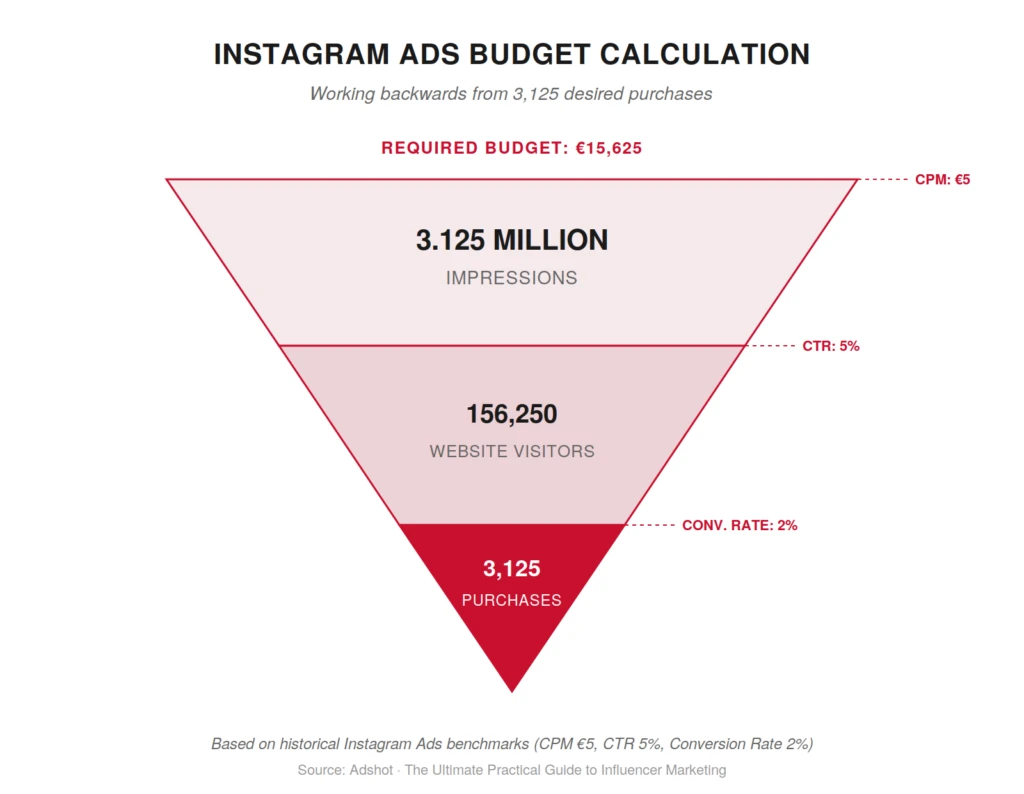
To generate 3,125 sales at a 2% conversion rate, the brand needs 156,250 website visits. With a 5% CTR, that requires 3.125 million impressions. At a CPM of €5, the total Instagram Ads budget needed is €15,625.
TikTok calculation
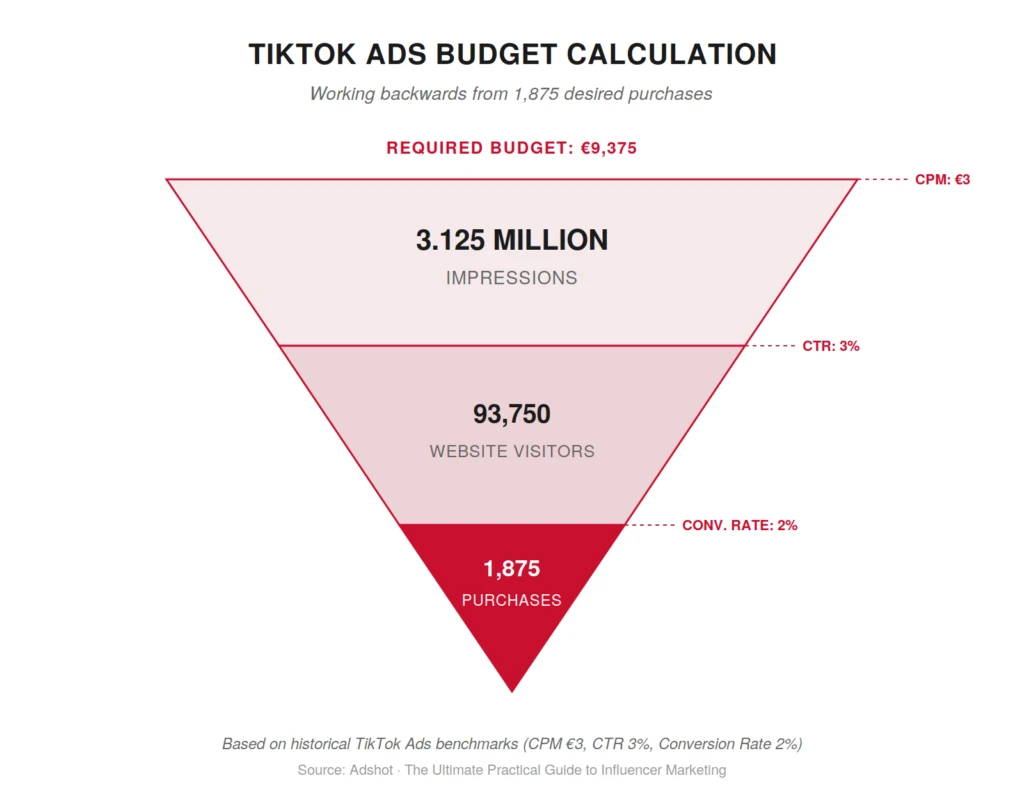
To generate 1,875 sales at a 2% conversion rate, the brand needs 93,750 website visits. With a 3% CTR, that requires 3.125 million impressions. At a CPM of €3, the total TikTok Ads budget needed is €9,375.
What this tells us
Notice that both channels need exactly the same number of impressions (3.125 million) to hit their conversion targets, but for very different reasons. Instagram has a higher CPM and a higher CTR, so you pay more per impression but more clicks come out of those impressions. TikTok is the opposite: cheaper per impression, but it takes more impressions to drive the same click volume. The total budget per platform reflects this dynamic.
The total ad budget across both channels for this campaign is €25,000, with a clear forecast of impressions, visits, and conversions per platform. That is the kind of forecast that lets you defend a budget internally and report against it afterwards.
Frequently asked questions
What if I do not have historical data yet?
Any social advertising data you have access to is a good starting point, even if it was not used to amplify influencer content. CPM, CTR, and conversion rates from your regular Meta or TikTok ads give you a realistic baseline. On top of that, both Meta Ads and TikTok Ads have built-in forecasting tools. When you set up a campaign and define your objective, audience, and budget, the platform shows you an expected CTR and CPM range. This range is often quite wide, but it gives you a sense of what to expect before you launch. Use it as directional input, then refine your numbers after your first campaign delivers real data.
Should I run the same objective on both channels?
Not necessarily. You can run different objectives per channel based on what each platform is best at. For example, you might run a conversion objective on TikTok if it has historically driven your strongest sales, and a reach objective on Instagram for broader awareness. The calculation logic stays the same, you just use the relevant benchmark for each combination of channel and objective. We covered campaign objectives and KPIs in more detail in our blog on KPIs and how to make sense of campaign results.
Should I split my budget evenly across both platforms?
Not automatically. How you allocate budget across channels should reflect the conversion target per channel and the historical performance of each platform for your brand. In the example above, we split the budget proportionally to the number of posts per channel (five Instagram, three TikTok), but in practice it is often smarter to put more budget behind the channel that historically performs better on your specific objective. If TikTok consistently drives stronger conversions for your brand, weighting the budget toward TikTok will deliver better total results than a clean 50/50 split. Use historical performance as the deciding factor, not gut feeling or what feels fair.

